


How to Choose a Waterless Aroma Diffuser Manufacturer for Your Brand
2026-08-07 18:07:43
Click:
“
Choosing the right waterless aroma diffuser manufacturer is essential for brands looking to enter or expand in the home fragrance market. This guide explains how to evaluate OEM/ODM suppliers, including manufacturing capability, customization options, quality control, certifications, MOQ, and long-term partnership potential.
”
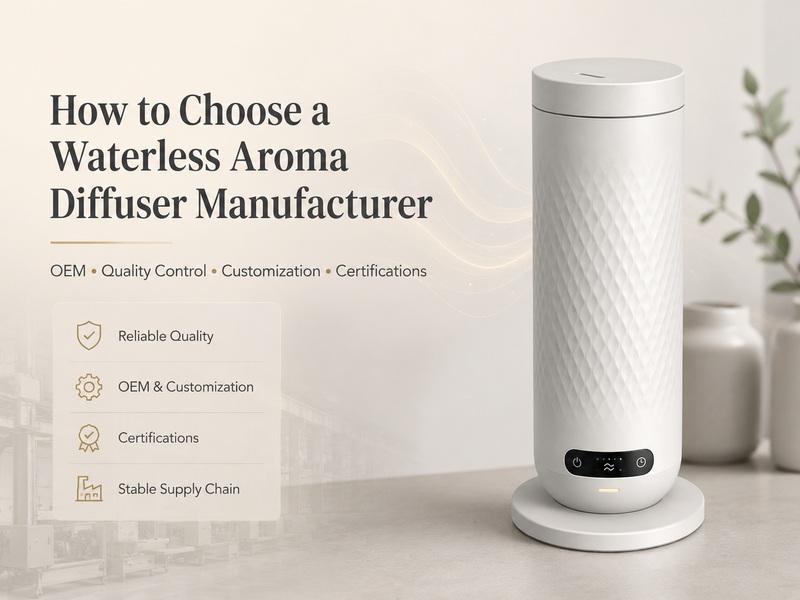
Industry News | Aroma Diffuser Manufacturing | OEM/ODM Solutions
How to Choose a Waterless Aroma Diffuser Manufacturer for Your Brand
A practical guide for brands, importers, and distributors evaluating waterless aroma diffuser manufacturers, including OEM capability, customization, quality control, certifications, and supplier selection criteria.
✓ Waterless Diffusion Technology✓ OEM/ODM Manufacturing✓ Premium Fragrance Solutions
Key Takeaways
- A reliable waterless aroma diffuser manufacturer provides more than production capability — they support product development, customization, engineering, and quality management.
- OEM/ODM capability allows brands to create differentiated fragrance products instead of competing only through price.
- Supplier evaluation should include manufacturing experience, quality control, certification capability, MOQ, and after-sales support.
- The right manufacturing partner helps brands expand into premium home fragrance and commercial scenting markets.
Table of Contents
- Why Choosing the Right Waterless Aroma Diffuser Manufacturer Matters
- Understand What Makes a Professional Waterless Diffuser Supplier
- Key Factors to Evaluate a Waterless Aroma Diffuser Manufacturer
- Waterless Aroma Diffuser Manufacturing Trends Brands Should Know
- Questions to Ask Before Selecting a Waterless Diffuser Factory
- Why Choose Haojing as Your OEM Partner
- Frequently Asked Questions
Choosing the right waterless aroma diffuser manufactureris one of the most important decisions for brands entering or expanding in the home fragrance market.
A reliable manufacturing partner does more than provide products — they support product development, customization, quality control, compliance, and long-term business growth.
As consumers increasingly look for premium fragrance experiences without the limitations of traditional water-based diffusers, waterless aroma diffusers are becoming an attractive category for home fragrance brands, retailers, and professional scenting companies.
However, selecting the right supplier requires careful evaluation of manufacturing capability, technical expertise, and business alignment.
01. Why Choosing the Right Waterless Aroma Diffuser Manufacturer Matters
The fragrance industry is moving beyond basic humidifying diffusers. Consumers are becoming more interested in products that offer stronger fragrance performance, elegant product designs, easier maintenance, portable usage scenarios, and premium lifestyle experiences.
Unlike traditional ultrasonic diffusers that mix essential oils with water, waterless aroma diffusers use technologies such as nebulization or direct oil diffusion to deliver fragrance without adding water.
Brand Opportunities
- Develop premium home fragrance products
- Increase average order value through higher-value devices
- Build refill-based fragrance business models
- Create differentiated product collections
- Expand into hospitality and commercial scenting markets
However, product success depends heavily on the manufacturing partner behind the product.
A manufacturer with strong engineering capabilities can help a brand transform an idea into a market-ready product. A supplier without sufficient experience may create challenges related to product stability, fragrance performance, appearance quality, certification, and after-sales issues.
Therefore, choosing the right factory is not only a purchasing decision — it is a strategic brand decision.
02. Understand What Makes a Professional Waterless Diffuser Supplier
A professional waterless aroma diffuser supplier should provide much more than basic production. The best manufacturers usually combine product development capability, engineering support, manufacturing experience, quality management, customization services, and compliance support.
Key Supplier Capabilities
- Product development capability
- Engineering support
- Manufacturing experience
- Quality management
- Customization services
- Compliance support
Product Development Capability
The fragrance market changes quickly. Brands often need products that match specific market positioning, such as premium home fragrance, portable personal scenting, hotel and hospitality fragrance solutions, retail gift products, and commercial scent systems.
A capable manufacturer should be able to support product development from the early concept stage.
01. Product Structure Design
Optimize internal structure and product performance for reliable mass production.
02. Industrial Design Support
Develop product appearance that matches brand positioning and target markets.
03. Functional Testing
Validate product performance before moving into mass production.
For example, a brand developing a premium tower waterless diffuser may need support with exterior design, fragrance output performance, noise optimization, oil compatibility, and user experience improvements.
A factory with R&D capability can help reduce development risks and shorten time to market.
OEM and ODM Manufacturing Experience
When selecting a waterless aroma diffuser manufacturer, brands should evaluate whether the supplier has real OEM/ODM experience.
OEM Capability Includes:
- Logo customization
- Packaging design
- User manual customization
- Product appearance changes
- Color customization
ODM capability goes further by helping brands develop new products based on market needs.
ODM Development Support
- New product concepts
- Mechanical design
- Electronic engineering
- Prototype testing
- Mass production preparation
For growing fragrance brands, ODM capability provides a competitive advantage because it allows companies to launch differentiated products instead of competing only on price.
03. Key Factors to Evaluate a Waterless Aroma Diffuser Manufacturer
Selecting a manufacturer requires a structured evaluation process. Brands should compare suppliers based on manufacturing experience, product quality, customization capability, MOQ flexibility, certification support, and long-term cooperation potential.
Supplier Evaluation Checklist
- ✓ Manufacturing experience and production capability
- ✓ Product quality and testing standards
- ✓ OEM/ODM customization capability
- ✓ MOQ and production flexibility
- ✓ Certification and compliance support
- ✓ After-sales service and communication ability
1. Manufacturing Experience and Production Capability
A factory's experience directly affects product reliability. Brands should evaluate whether the manufacturer has experience producing aroma devices, understanding waterless diffusion technology, and supporting international customers.
Important evaluation points include:
- How long the manufacturer has been producing aroma devices
- Experience with waterless diffusion technology
- Production capacity
- Engineering team capability
- Existing global customers
Oil Compatibility
Different fragrance oils require proper material selection and diffusion optimization.
Atomization Stability
Stable fragrance output is essential for premium user experience.
Noise Control
Optimized structure helps improve product acceptance in home and commercial environments.
A supplier experienced in aroma products understands these details and can help brands reduce development risks.
2. Product Quality and Testing Standards
Product quality is one of the biggest differences between manufacturers.
| Quality Factor | What Brands Should Check | Business Impact |
|---|---|---|
| Material Quality | Plastic materials, electronic components, battery safety, oil compatibility | Improves product reliability |
| Performance Testing | Fragrance output, operating stability, noise, durability | Ensures better customer experience |
| Quality Control | Incoming inspection, production inspection, final testing | Reduces returns and complaints |
3. OEM/ODM Customization Capability
Different brands have different market positioning. A premium fragrance brand may require unique appearance design, customized packaging, and exclusive product solutions.
Common Customization Options
- Product color customization
- Housing design adjustment
- Logo placement
- Surface treatment
- Timer and function customization
- Remote control or battery options
- Retail packaging development
The ability to customize allows brands to create stronger differentiation in competitive fragrance markets.
4. MOQ and Production Flexibility
Minimum order quantity (MOQ) is an important consideration, especially for brands launching new products.
- Standard MOQ requirements
- Sample process
- Pilot order options
- Production scaling ability
Why MOQ Matters
Lower MOQ helps brands test market demand and reduce inventory risk. However, extremely low MOQ may affect production efficiency, product consistency, and cost competitiveness.
5. Certifications and Compliance
For international markets, compliance capability is essential.
- CE compliance
- FCC compliance
- RoHS compliance
- Product safety testing
- Quality management documentation
A professional manufacturer should understand export requirements and help brands prepare necessary documentation for different markets.
04. Waterless Aroma Diffuser Manufacturing Trends Brands Should Know
Understanding market trends helps brands choose the right product direction.
Premium Home Fragrance
Consumers increasingly view fragrance products as lifestyle products rather than simple household accessories.
Application:
Home / Gift Market / Luxury Lifestyle
Portable Diffusers
Compact fragrance products provide flexible usage for modern consumers.
Application:
Bedroom / Office / Travel
Commercial Scenting
Professional fragrance solutions for hotels, retail stores, spas and offices.
Application:
Hospitality / Retail / Business
05. Questions to Ask Before Selecting a Waterless Diffuser Factory
Before choosing a manufacturing partner, brands should prepare a clear supplier evaluation checklist. The following questions help identify whether a manufacturer is suitable for long-term cooperation.
Do You Support OEM and Private Label Projects?
A professional manufacturer should support different brand development stages, including logo customization, packaging customization, product appearance modification, and exclusive product development.
What Is Your Minimum Order Quantity (MOQ)?
Brands should understand sample quantity requirements, trial order options, standard production MOQ, and cost differences between different order quantities.
Can You Customize the Product Design?
Product differentiation is important in the fragrance market. Brands should confirm whether suppliers can support industrial design adjustments, housing customization, color options, control functions, and packaging development.
What Certifications Can You Provide?
International brands should confirm available compliance documents, including CE, FCC, RoHS, safety testing reports, and quality management documents.
How Do You Control Product Quality?
A structured quality system should include incoming material inspection, production line inspection, finished product testing, reliability testing, and quality feedback processes.
Why Choose Haojing as Your OEM Partner
Haojing (Shenzhen) Technology Co., Ltd. specializes in OEM/ODM manufacturing for aroma devices and consumer electronics products.
With experience in aroma diffuser development, Haojing supports brands, importers, distributors, and retail partners with complete product development and manufacturing solutions.
Haojing Manufacturing Advantages
- ✓ OEM/ODM Capability
- ✓ Product Development Support
- ✓ Industrial Design Support
- ✓ Quality Control Management
- ✓ Global Market Experience
Factory Experience
Haojing focuses on developing and manufacturing:
- Waterless aroma diffusers
- Nebulizing diffusers
- Wall plug-in diffusers
- Tower aroma diffusers
- Commercial scenting devices
R&D and Engineering Capability
From concept development to mass production, Haojing provides engineering support including:
- Product structure optimization
- Industrial design support
- Prototype development
- Function improvement
- Production engineering
Develop Your Next Product With Haojing
Looking for a reliable waterless aroma diffuser manufacturer for your brand? Haojing provides OEM/ODM aroma diffuser solutions with product development, customization, engineering support, and quality management.
Request OEM SolutionFrequently Asked Questions
FAQ 1: What is a waterless aroma diffuser?
A waterless aroma diffuser is a fragrance device that disperses essential oils or fragrance oils without using water. Compared with traditional ultrasonic diffusers, it provides stronger fragrance concentration, easier maintenance, and a more premium positioning.
FAQ 2: How do I choose a reliable aroma diffuser manufacturer?
A reliable manufacturer should have proven manufacturing experience, OEM/ODM capability, strong quality control, certification experience, stable production capacity, and good communication support.
FAQ 3: What MOQ is required for OEM waterless aroma diffusers?
MOQ depends on product design, components, customization requirements, and packaging needs. Brands should discuss MOQ requirements during the product planning stage.
FAQ 4: Can manufacturers customize waterless aroma diffusers?
Yes. Professional OEM/ODM manufacturers can customize appearance, logo, packaging, functions, fragrance output settings, and accessories.
FAQ 5: What certifications should aroma diffuser suppliers provide?
Common requirements include CE, FCC, and RoHS compliance. Specific requirements depend on the destination market and product category.
Related Products
Waterless Aroma Diffuser
Premium fragrance solution for home fragrance brands, retailers, and lifestyle products.
Nebulizing Diffuser
High-performance fragrance diffusion solution for premium and commercial applications.
Commercial Scent Diffuser
Professional scenting solutions for hotels, retail stores, offices, and hospitality spaces.
Related Articles
- How OEM Aroma Diffuser Manufacturing Helps Brands Build Premium Products
- Waterless Aroma Diffuser vs Ultrasonic Diffuser: Which Is Better for Your Brand?
- A Complete Guide to Private Label Aroma Diffusers
Author:
Haojing Technology(Shenzhen) Co., Ltd









Contact

+18681541980

Beckli@vvpec.com

Building E, N.O 139, 2nd Chuangye Road, Baoan District, Shenzhen, China

Business Hours: Mon–Fri, 9:00–18:00 GMT+8
Follow and subscribe to us


Copyright © Haojing(Shenzhen) Technology Co., Ltd
